What's the Average ROI on Lighting Upgrades for a Flip in Monroe County, NY?
A typical flip in Rochester and the rest of Monroe County, NY spends about $1,800–$3,500 on lighting and sees roughly $5,000–$9,500 in perceived value increase. That works out to a modeled return of about 150%–200%, or around $2.80 in perceived value for every $1 spent. A blended average lands near $2,600 spent and $7,000 in perceived value.
These figures are modeled estimates built from common flip budgets and buyer-perception patterns. They are not audited sales data.
Question 1: Why does lighting matter more for a Rochester-area flip?
Answer: Rochester's long, overcast winters and Monroe County's older housing stock make interiors look dim in photos and showings. Good fixtures are one of the cheapest ways to fix that.
- Gray-season listings. Rochester is among the cloudier metro areas in the U.S., and flips often list in fall, winter, and early spring, when natural light is weakest. Fixtures with warm, even output help rooms photograph brighter.
- Older homes. Many homes in the city of Rochester and inner-ring suburbs such as Irondequoit, Brighton, and Greece were built decades ago, often with smaller windows, lower ceilings, and dated builder-grade fixtures.
- Suburban resale competition. In towns like Penfield, Webster, Henrietta, and Pittsford, buyers compare against updated listings, so mismatched or aging fixtures stand out.
- Modeled effect. We assume updated lighting is a meaningful part of the "finished and move-in ready" impression, which is where the perceived-value figures below come from.
Question 2: How much should a Monroe County flipper spend on lighting, and what comes back?
Answer: Most flips fall into one of three lighting budgets. The middle tier tends to give the best balance of cost and perceived value, because it upgrades the fixtures buyers notice first and keeps low-visibility rooms on simple, coordinated basics.
| Tier | Amount spent | Perceived value increase | Modeled ROI |
|---|---|---|---|
| Essential refresh | $800–$1,800 | $2,500–$5,000 | ~130%–180% |
| Targeted upgrade | $1,800–$3,500 | $5,000–$9,500 | ~150%–200% |
| Full designer package | $3,500–$6,500 | $8,000–$14,000 | ~120%–170% |
- Modeled inputs: 12 to 18 fixture locations, with 4 to 6 statement fixtures and the rest as coordinated basics.
- Modeled perceived value: based on the difference buyers and agents tend to assign to a "finished, updated" interior versus builder-grade or dated fixtures. It is a perception estimate, not an appraisal figure.
- Why returns flatten at the high end: once the entry, kitchen, and dining area are upgraded, extra spending goes to rooms that photograph less and influence offers less.
This sample uses the four fixtures recommended in Question 4 across 14 locations. Fixture prices are current Jojospring listing prices; installation and supplies are modeled estimates.
| Item | Qty | Unit price | Line total |
|---|---|---|---|
| Clara Mini Pendant | 3 | $77.30 | $231.90 |
| Bethany 5-Light Chandelier | 1 | $118.12 | $118.12 |
| Silver Orchid Taylor Flush Mount | 6 | $104.04 | $624.24 |
| Evelyn 4-Light Wall Sconce | 4 | $112.00 | $448.00 |
| Fixture subtotal (14 fixtures) | $1,422.26 | ||
| Licensed installation, bulbs, and hardware (modeled) | $600–$1,400 | ||
| Modeled package total | ~$2,000–$2,800 | ||
- The modeled total falls inside the $1,800–$3,500 targeted-upgrade range.
- Fixtures alone are a little over $1,400. Most of the remaining budget is installation labor, which is why keeping fixture prices moderate leaves room to hire a licensed electrician.
Question 3: Which rooms give Monroe County flippers the best lighting ROI?
Answer: In our model, the entry, kitchen, and dining area return the most per dollar, followed by the primary bathroom and living room. Secondary bedrooms and closets return the least.
| Room | Typical spend | Modeled perceived value |
|---|---|---|
| Entry | $250–$600 | $900–$2,000 |
| Kitchen (island and ceiling) | $400–$1,000 | $1,500–$3,000 |
| Dining area | $250–$700 | $1,000–$2,200 |
| Primary bath (vanity) | $150–$500 | $600–$1,500 |
| Living room and hallways | $200–$500 | $500–$1,200 |
| Secondary bedrooms | $100–$300 | $200–$600 |
- The room ranking follows buyer walk-through order and listing photo order: entry, kitchen, dining, then bathrooms.
- Ranges assume mid-priced fixtures, not custom or imported pieces.
Question 4: Which Jojospring fixtures should a Rochester-area flip use?
Answer: Four Jojospring fixtures cover the main visibility points in a flip: a sputnik pendant for the entry, a candle chandelier for the dining area, a crystal flush mount for bedrooms and halls, and a crystal sconce for hallways and living areas. One of each costs $411.46 at current listing prices.
- Pendant: Clara Mini Pendant, 6-light chrome sputnik with clear crystal balls ($77.30)
- Use it in the entry or foyer, the first fixture a buyer sees and a common lead photo. The chrome sputnik shape with clear crystal balls throws sparkle in a dim room, which helps in gray-season Rochester listings. At $77.30 it is inexpensive enough to repeat in a second location, such as a stairwell or breakfast nook.
- Dining chandelier: Bethany 5-Light Iron and Crystal Candle Chandelier ($118.12)
- A candle-style chandelier with iron and crystal defines the dining area and helps buyers picture the room in use. Its traditional silhouette suits the colonials, Tudors, and center-hall homes common across Monroe County.
- Flush mount: Silver Orchid Taylor Iron Shade Crystal Flush Mount Chandelier ($104.04)
- A flush mount sits close to the ceiling, which matters under the lower ceilings found in many older Monroe County homes. Use it in bedrooms, hallways, and other rooms that need a finished look without a full chandelier drop. Repeating one style across rooms gives the house a consistent, intentional feel.
- Sconce: Evelyn 4-Light Crystal Strand Wall Sconce ($112.00)
- Use sconces in a hallway, along a stair wall, or beside a fireplace or mirror to add layered light that makes dim spaces feel warmer. Pairs of sconces also give a room a symmetrical, styled look in listing photos.


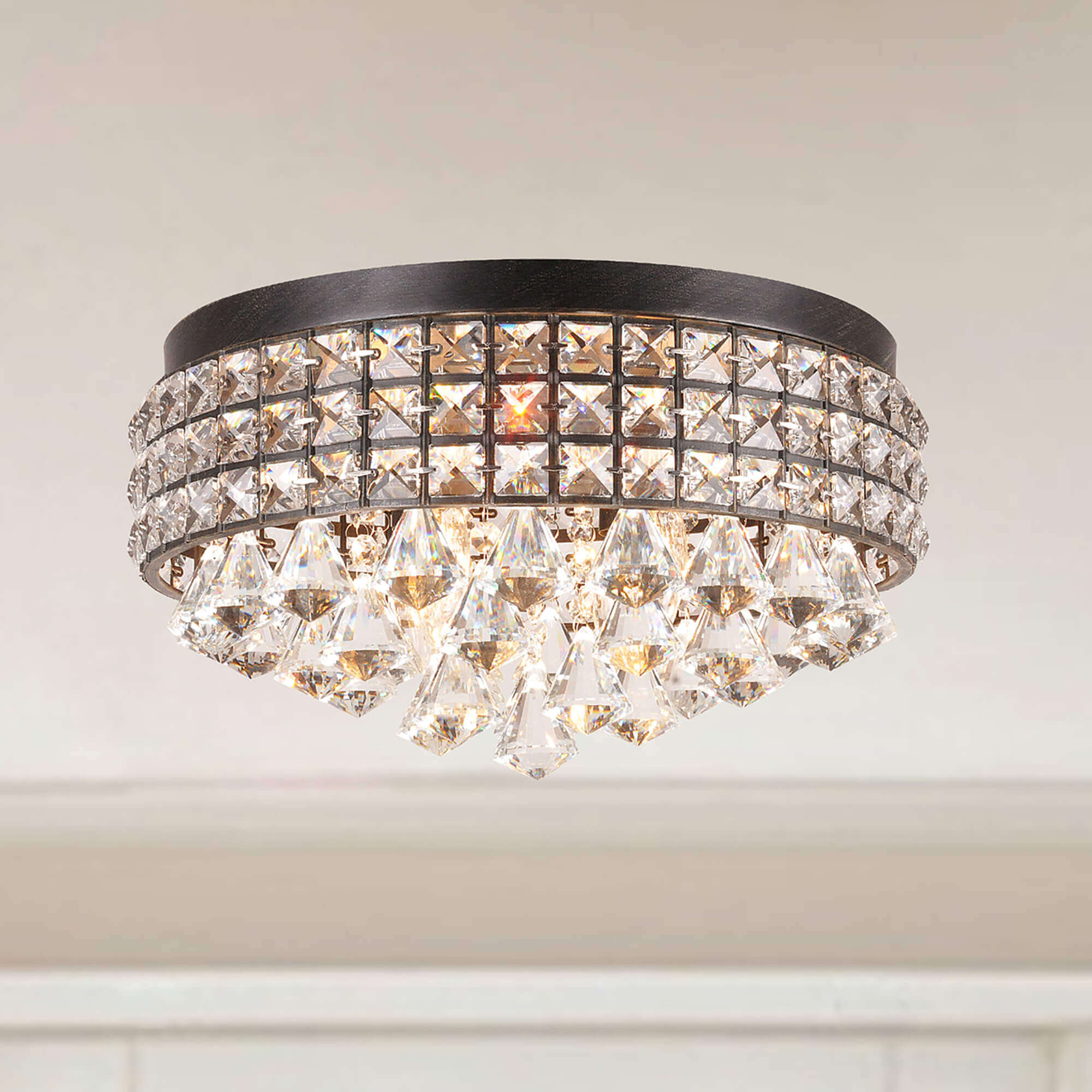

Style fit: these fixtures lean traditional and glam, with chrome, iron, and crystal. They suit traditional and transitional interiors best. For a modern-farmhouse or industrial flip, choose fixtures that match that design direction instead.
Question 5: What assumptions sit behind these numbers?
Answer: The model assumes a single-family flip in Monroe County, NY, a 1,300–1,800 sq ft floor plan, fixtures purchased at retail or online prices, and licensed electrical installation on existing boxes. It does not include new wiring, recessed can retrofits, or rewiring for structural changes.
- ROI formula used: (perceived value increase − amount spent) ÷ amount spent.
- Blended average: about $2,600 spent and $7,000 perceived value, or roughly a 170% return.
- To check locally: compare your fixture spend against days on market and offer counts for similar comps in your target town, whether that is the city of Rochester, Irondequoit, Greece, Brighton, or Webster.
- Permits: confirm electrical permit requirements with the City of Rochester or your town's code office before starting work.
Frequently asked questions
Is it worth replacing every fixture in a flip?
Usually not. Put most of the budget into three to five high-visibility fixtures and use coordinated, budget-friendly fixtures elsewhere.
Do lighting upgrades raise the appraisal?
Not directly in most cases. Appraisers focus on condition, comparable sales, and square footage. Lighting mainly influences buyer perception, photos, and offer strength.
Should a flipper hire an electrician for fixture swaps?
Yes, in most cases. Licensed installation protects the flip from code and inspection problems, and swaps on existing boxes are a small labor cost.
What finish should a Rochester-area flip use?
Pick one finish family, such as chrome, brushed nickel, or matte black, and repeat it across fixtures and hardware. Consistency reads as intentional design.